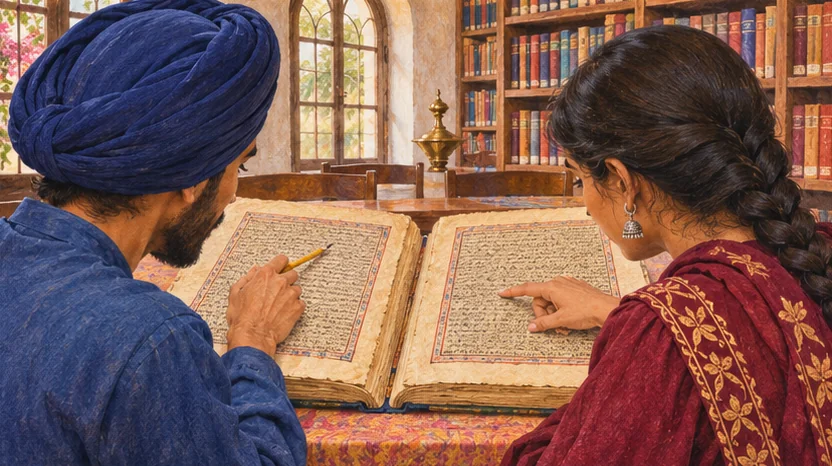
Do lok ikko Punjabi gall samajh sakde ne, par ik duje di likhat parhna ohna layi aukha ho sakda hai. Gurmukhi te Shahmukhi Punjabi likhan de vakhre dhang ne; Roman Punjabi Latin akhran raahin hor darwaza kholhdi hai. Kise di lipi di samajh ohdi Punjab naal saanjh da paimana nahi. SANJH rasala ikko samagri Gurmukhi te Shahmukhi vich chhapda hai, te Punjabi University da Janamsakhi kam vi donon lipiyan vich parhan da mauka dinda hai. Lafzan nu hor akhran vich likhna te ohna da matlab hor boli vich dassna vakhre kam ne. Kahani di lipi badle taan raavi di awaaz te matlab sambhal ke rakhiye. Language di chon bande nu apni pasand de raah saanjhi gall vich liaave.
Poora khoj lekh — English
Begin with the reader
Two people may understand the same Punjabi sentence when it is spoken and still be unable to read one another’s writing. Gurmukhi and Shahmukhi give Punjabi different written forms, with different letter shapes and directions of reading. Roman Punjabi offers another route through Latin letters, especially for readers who learned to type in English. A person’s reading confidence does not measure how much they belong to Punjab.
On this website, the useful goal is access to the same meaning. A visitor should be able to choose a comfortable script, understand the navigation and return to a story without feeling that another community’s knowledge has been placed out of reach. Good language design is therefore part of the cultural work, not a finishing decoration.
Connection already exists
SANJH magazine describes publishing identical content in separate Gurmukhi and Shahmukhi volumes from Ludhiana and Lahore. Punjabi University’s online Puratan Janamsakhi project makes a historical text available in both scripts. These projects show that a script boundary need not become a boundary around readers. The same work can be made accessible through deliberate editorial and technical choices.
Transliteration and translation serve different purposes. Transliteration helps carry a word’s sound into another script; translation explains or restates its meaning in another language. Neither should silently change a poet’s verse or turn a dialect word into an invented standard. A proper name, an agricultural term or a remembered village expression may need a small note rather than automatic replacement.
Keep the texture of a voice
For personal stories, ask contributors which language and script they prefer. If a voice note is transcribed, preserve meaningful dialect features while making the text readable. A speaker should not emerge from editing sounding like an entirely different person. When captions or translations are added, give the contributor an opportunity to flag a changed meaning where possible.
Roman spelling is especially variable. One person may write a long vowel one way and another person differently. The website can make search forgiving while leaving the contributor’s chosen wording visible. A glossary can connect related spellings, and a short pronunciation or meaning note can help a learner without turning every page into a textbook.
A shared room
The language selector should be an invitation to move, not a demand to choose a side. English can help readers who are still learning Punjabi, and bilingual introductions can give them a starting point. Gurmukhi and Shahmukhi can stand beside one another with equal care in type, spacing and readability. A beautiful page in one script should not become an awkward afterthought in another.
For a community scattered across countries, this is a practical form of hospitality. The person reading a poem in Toronto, the elder recording a village memory near Jhang and the student typing from Amritsar may enter by different doorways. What connects them is the willingness to make the next person’s reading possible. That is a strong foundation for a shared Punjabi culture online.