- type
- Hopping and balancing game
- players
- One or more players taking turns
- equipment
- Chalk or a marked court and a small marker
- setting
- Level courtyard or playground
Stappu layi zameen utte khaane ate ikk chhoti geeti jaan marker chahida ae. Marker nu muqarrar khaane vich sutto, us khaane nu chhad ke langho ate murde hoye chukko. Khaane di banawat, pair rakhhan da dhang ate galti magron vaari pind ton pind badal sakdi ae. Lahore de 2025 de virasati programme vich vi stappu shamil si. Ghar de session layi khidarian de qad te thaan mutabiq khaane banao; kise bache nu vadde faasle te chhaal maran layi majboor na karo. Kis ne court banaya, geeti nu ki kehnde si ate line utte pair rakhan da ki faisla hunda si, eh yaadan likhan jog ne.
Pind te ilaqe mutabiq naa ate asool badal sakde ne. Apni riwayat sanjhi karde hoye thaan, samaa ate sikhaun wale bande da naa daso. Tafseeli lekh de hawale vi parho; ajj di tabdeeli nu purani riwayat ton vakh pachhano.
Poora khoj lekh — English
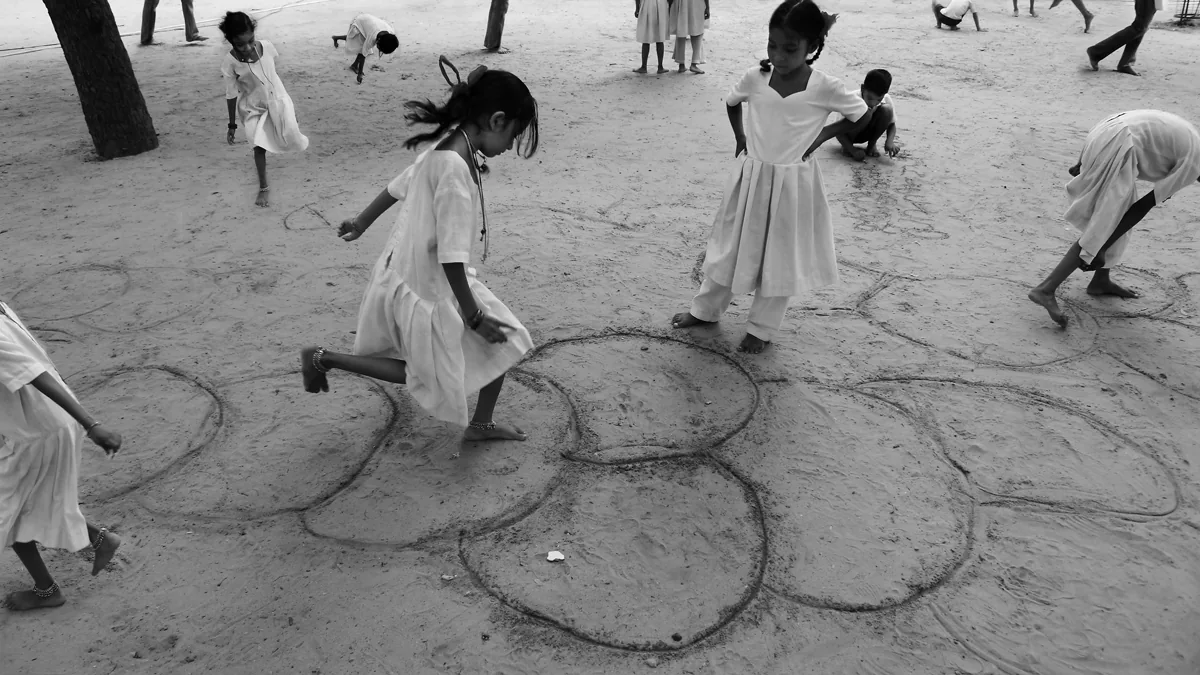
Stappu is part of the hopscotch family: a pattern marked on the ground, a small marker and a sequence of controlled hops. The court might be scratched into earth or drawn in chalk. Its size and arrangement are part of the local version, so a remembered childhood diagram is often more useful than an assertion that every game had the same shape.
The Traditional Games Federation of India’s hopscotch guide describes tossing a marker into a numbered space, hopping through the court while avoiding the marked square, turning at the far end and retrieving the marker on the return. Paired side-by-side squares allow a different landing pattern from single squares. A turn can end when the marker misses its target, a foot touches a line or balance is lost.
Stappu was among the games named in WCLA’s October 2025 heritage event in Lahore. That dated example places a familiar courtyard game within an active cultural programme, rather than treating it only as something that belongs in a photograph of the past.
For a family session, draw a court suited to the space and the players rather than forcing a child to stretch between oversized boxes. Agree whether the marker is picked up or moved in some other local way, and whether a failed turn restarts from the same number. These choices make the game understandable to people who grew up with different versions.
A chalk court can also be a prompt for a story: who drew it, what counted as a fair landing and which name your neighbourhood used. The rhythm of waiting, hopping and balancing can survive a change of city or country, even when the first court you remember is far away.