- type
- Spinning-toy skill game
- players
- Individuals taking turns or a locally agreed contest
- equipment
- Spinning top and launching string
- setting
- Level, unobstructed playing surface
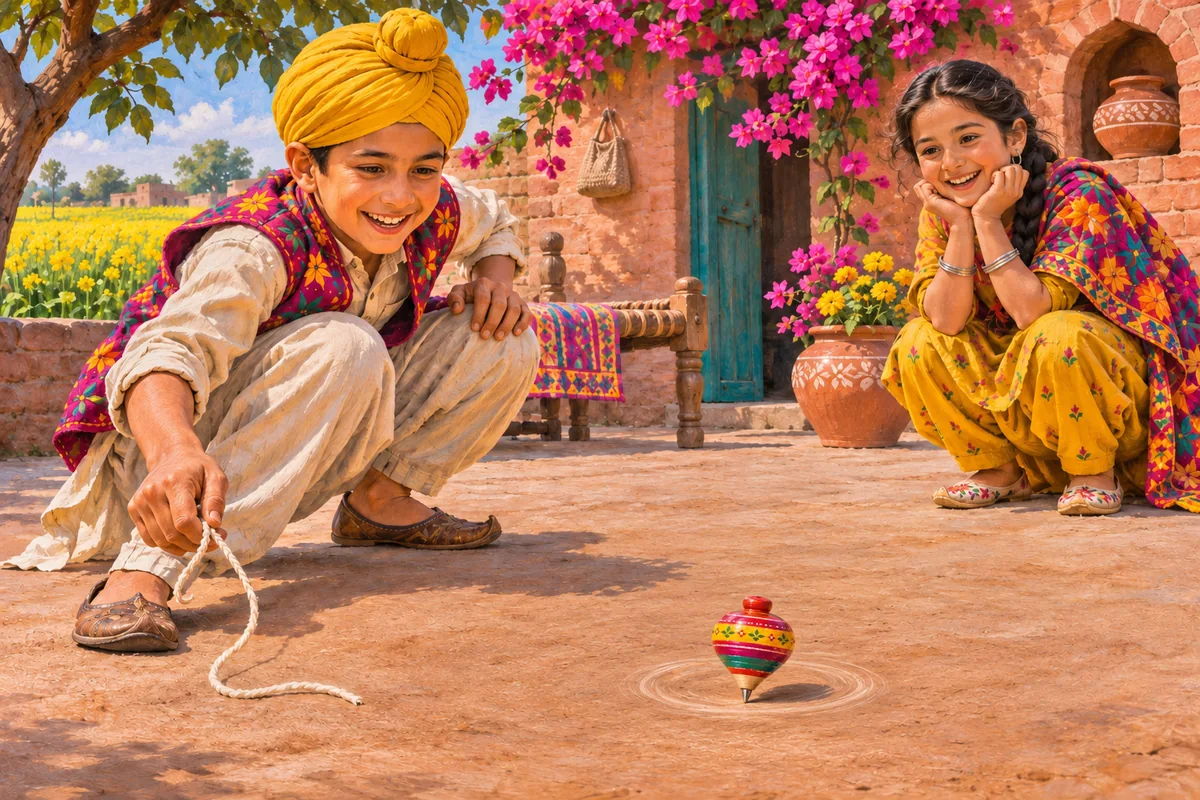
Latto jaan lattu lakri da ghooman wala khidona ae. Dori lapet ke chhaddan naal oh apni nok utte ghoomda ae. Kujh roopan vich ghooman da samaa naapeya janda ae, horan vich nishan lagge ghere jaan lattoan di takkar da mukaabla hunda ae. Shuruaat layi saaf, padhri thaan te vakh-vakh vaarian naal ghooman da samaa vekhna asaan tareeqa ae. Dori, pakar jaan release vich ikk tabdeeli karke farak samjho. Nok wale latto nu nange pairan ton door rakho. Latto de rang, kharadi da naa ate kis ne pehli vaar chalauna sikhaya, eh vi Punjabi bachpan da record ne.
Pind te ilaqe mutabiq naa ate asool badal sakde ne. Apni riwayat sanjhi karde hoye thaan, samaa ate sikhaun wale bande da naa daso. Tafseeli lekh de hawale vi parho; ajj di tabdeeli nu purani riwayat ton vakh pachhano.
Poora khoj lekh — English
A latto, also written lattu, is a spinning top. In the string-launched form, the player winds the string around the top, then releases it so that the pull starts its rotation. The attraction is immediate: a small object that would topple when still suddenly holds itself upright as it spins.
The Traditional Games Federation of India describes a wooden top, a point and a string, and records more than one way of playing. Its timed-spin variant is easy to understand: players take turns and compare how long their tops keep rotating. Other described versions involve a marked circle and contact between tops. Those are different contests, not steps that every beginner must follow.
Latto was also named in WCLA’s October 2025 traditional-games programme in Lahore. The toy therefore belongs both to personal childhood memory and to organised efforts to bring everyday games into a public cultural setting.
For a friendly introduction, choose a clear patch of level ground and agree to compare clean spins rather than damage one another’s toys. A simple timed round gives everyone repeated attempts and makes it easy to notice improvement. Try changing one thing at a time—the winding, the grip or the release—rather than assuming the hardest throw produces the best spin. This is a suggested learning format, not a universal local rule.
Keep pointed tops away from bare feet and give each thrower a separate release area. A photograph of the top can open a conversation about the person who made it, its colours and the names used in your street. The object is small enough to travel with a family; the technique often travels through demonstration.