- type
- Circle-and-chase game
- players
- A group sitting in a circle and one runner
- equipment
- A soft cloth, handkerchief or necker
- setting
- Open, level area around the seated circle
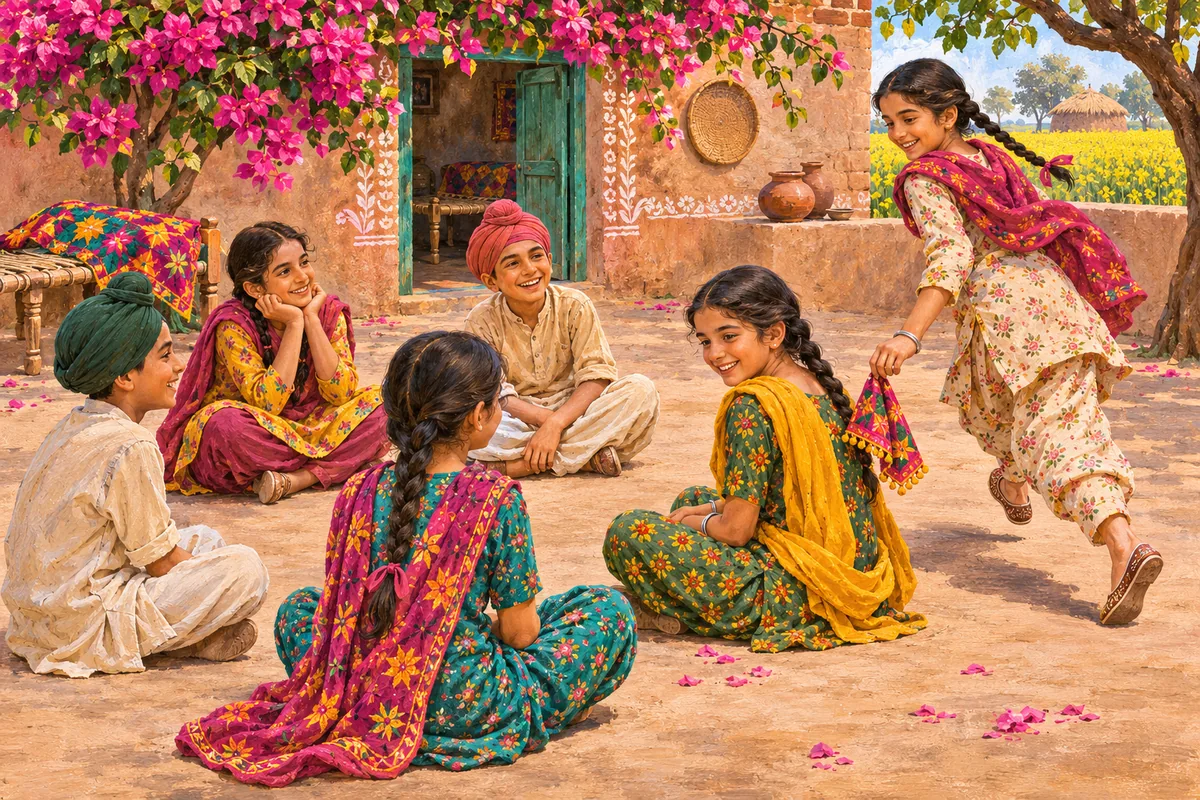
Kokla chapaki vich lok ghere vich baithde ne. Ikk khidari bahron rumal lai ke turda ae ate chupke kise de pichhe sutt dinda ae. Jis nu pata lagda ae, oh rumal chukk ke pehle khidari nu pharn layi bhajjda ae; pehla khidari khali thaan te baithan di koshish karda ae. Geet de bol te akheer har group vich vakh ho sakde ne. Eh khed diaspora youth sessions vich vi sikhai jandi ae. Nawan group pehlan ikk poora round vekhe. Naram chhoh, khulla raah ate zameen utte na baith sakkan wale layi kursi naal hor lok vi shamil ho sakde ne.
Pind te ilaqe mutabiq naa ate asool badal sakde ne. Apni riwayat sanjhi karde hoye thaan, samaa ate sikhaun wale bande da naa daso. Tafseeli lekh de hawale vi parho; ajj di tabdeeli nu purani riwayat ton vakh pachhano.
Poora khoj lekh — English
Kokla chapaki needs a group, a cloth and enough space to move around a seated circle. One person carries the cloth outside the circle while the others face inward. The runner quietly drops it behind a seated player; when that player notices, the chase begins.
The Bharatiya Khel guide explains the familiar outcome: the runner tries to complete the circuit and sit in the vacant place, while the player with the cloth tries to catch them first. If the runner reaches the place safely, the chaser takes over. A traditional rhyme can accompany the movement, with words and playful endings varying between groups.
The UK Scout Association includes Kokla Chapaki in its South Asian heritage activity guide, showing how a Punjabi street game can be taught in a diaspora youth setting. Its suggested equipment is a handkerchief or necker and an open space. This is not a game that requires a costly kit or a formal sports hall.
For a new group, demonstrate one complete round before asking everyone to join. Leave enough room between seated people for them to stand without stepping on one another, and use a gentle tag rather than grabbing or striking. A welcoming version lets anyone who finds floor sitting difficult use a suitable seat and adjusts the running route accordingly.
The point is not necessarily to produce a final champion. The suspense belongs to the whole circle: who has the cloth, who has noticed, and whether the empty place can be reached. If you remember a rhyme, share the place and person you learnt it from; one family’s wording need not replace another’s.