- type
- Aiming and turn-taking folk game
- players
- Local versions vary
- equipment
- Walnuts or locally remembered playing pieces; a marked target or small hole in some accounts
- setting
- Clear village courtyard or play space
Akhrot nu bachpan dian kujh khedan vich kanchian varge mohre vajon vartia janda si. 2014 di Roznama Dunya likhat zameen di chhoti khutti ate akhrot jaan golian nu nishana banaun da ikk maqami roop dasdi ae. Eh saare Punjab di ikko rulebook nahi. Pind, lagbhag dahaka, vaari da shuru hona ate sahi shot di shart purane khidari kolon puchho. Akhrot, patthar ate sheeshe di goli di banawat khed da dhang badal sakdi ae. Ajj di demonstration layi saaf thaan, bachian di nigrani ate munasib vadde mohre chuno. Mehngian cheezan di baazi di thaan dosti da maza rakho. Ijazat wala chhota video hath di chaal te lafaz sambhal sakda ae.
Pind te ilaqe mutabiq naa ate asool badal sakde ne. Apni riwayat sanjhi karde hoye thaan, samaa ate sikhaun wale bande da naa daso. Tafseeli lekh de hawale vi parho; ajj di tabdeeli nu purani riwayat ton vakh pachhano.
Poora khoj lekh — English
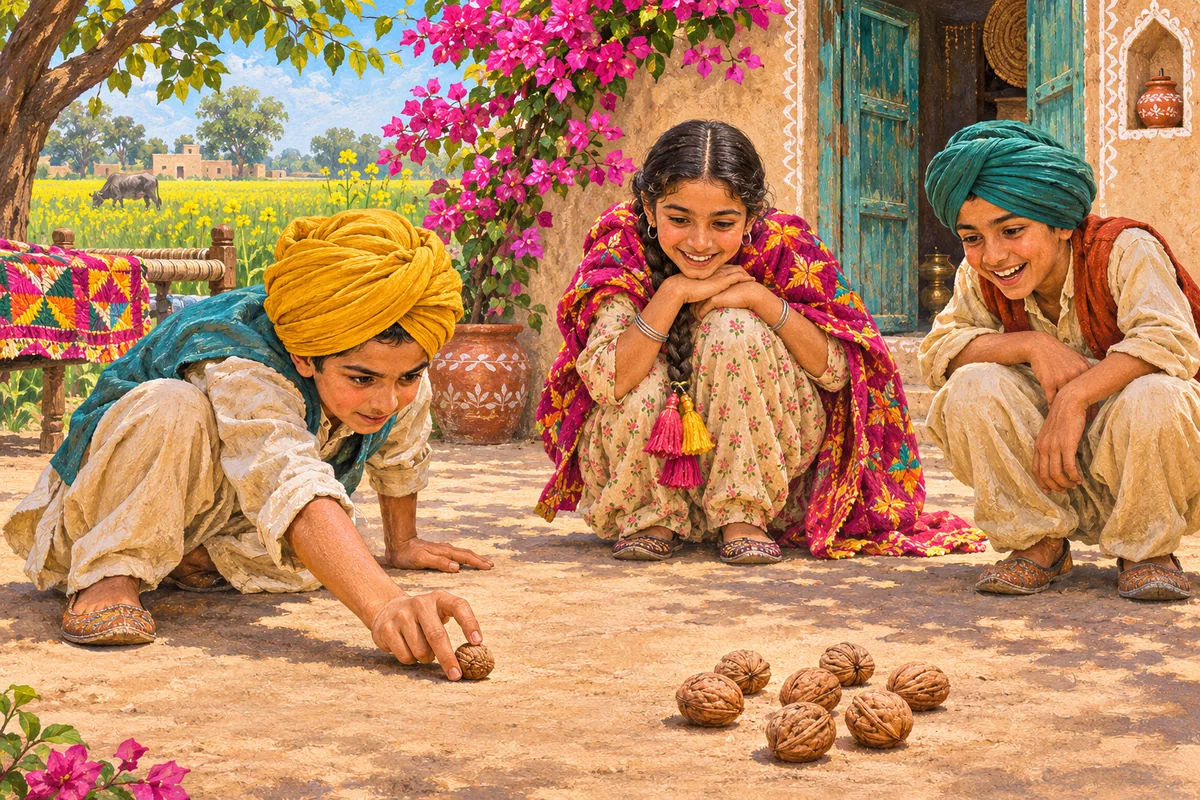
Akhrot is the Punjabi word for walnut. In remembered street games, walnuts could serve as playing pieces alongside glass marbles. Arif Jamil’s 2014 feature in Roznama Dunya describes a version involving a small hole in the ground and aiming at nuts or marbles. That is a reported local account, not a competition rulebook for all of Punjab.
The interest is in how a familiar household object became something to aim, count and take turns with. A useful family record starts with the village, approximate decade and the name used by the players. Ask how turns began, what counted as a successful shot and whether children kept their own pieces after a game. Record disagreements instead of smoothing them into one official version.
The material history matters too. A walnut, a pebble and a glass marble have different shapes and move differently on hard earth. Describing the objects helps another reader understand a memory without assuming every game with a nut was the same game. The Punjabi University dictionary is useful for the word itself; it does not supply a universal set of sporting rules.
For a present-day demonstration, choose a clear space, use suitable large pieces and adult supervision for children, and agree the rules before starting. Keep play friendly and avoid taking valuable possessions as stakes. A short, consented video of a local version can document the hand movements and vocabulary better than a confident claim that every family played identically.
What did your family call the aiming piece? Did the game use a hole, a target or another arrangement? Bring the memory to the community page, with your place and approximate period. The original illustration here evokes play in a village; it is not evidence of a particular historical match.