Sohni Mahiwal de qisse Hashim Shah, Qadaryar te Fazal Shah samet kai kaviyan ne likhe. Eh apne lafzan vich chhoti peshkaari hai; har roop de verve ikko jehe nahi. Gujrat di ghumiyaar di dhee Sohni te safar karde saudagar Izzat Beg da pyaar vadhda hai. Oh Mahiwal de naa naal jaaneya janda hai. Sohni da viaah hor thaan hon ton baad dariya ohna de vich raah vi banda hai te rukavat vi. Mashhoor kahani vich oh pakke ghare de aasre raat nu dariya langhdi hai. Jad kachcha ghara badal ditta janda hai, kahani dukhaant val tur paindi hai. Eh qissa himmat de naal ghar di marzi, aurat de faisle te mitti de hunar bare vi puchhda hai. Pyaar nu khatre jaan maut naal saabit karna is kahani da zaroori sabak nahi.
Poora khoj lekh — English
Clay at the beginning
Sohni Mahiwal survives through several Punjabi literary versions, including those associated with Hashim Shah, Qadaryar and Fazal Shah. Their episodes and emphases are not identical. This is an original prose retelling of the familiar tradition, not a translation of a modern text or a verified account of two historical lives.
The story begins in a world of clay and trade. Sohni is the daughter of a potter associated with Gujrat. A travelling merchant, often named Izzat Beg in the tradition, encounters the household and falls in love with her. He stays behind, loses the distance that wealth and travel once gave him, and becomes known as Mahiwal, the buffalo herder. The name places him inside the working landscape of the tale.
Across the water
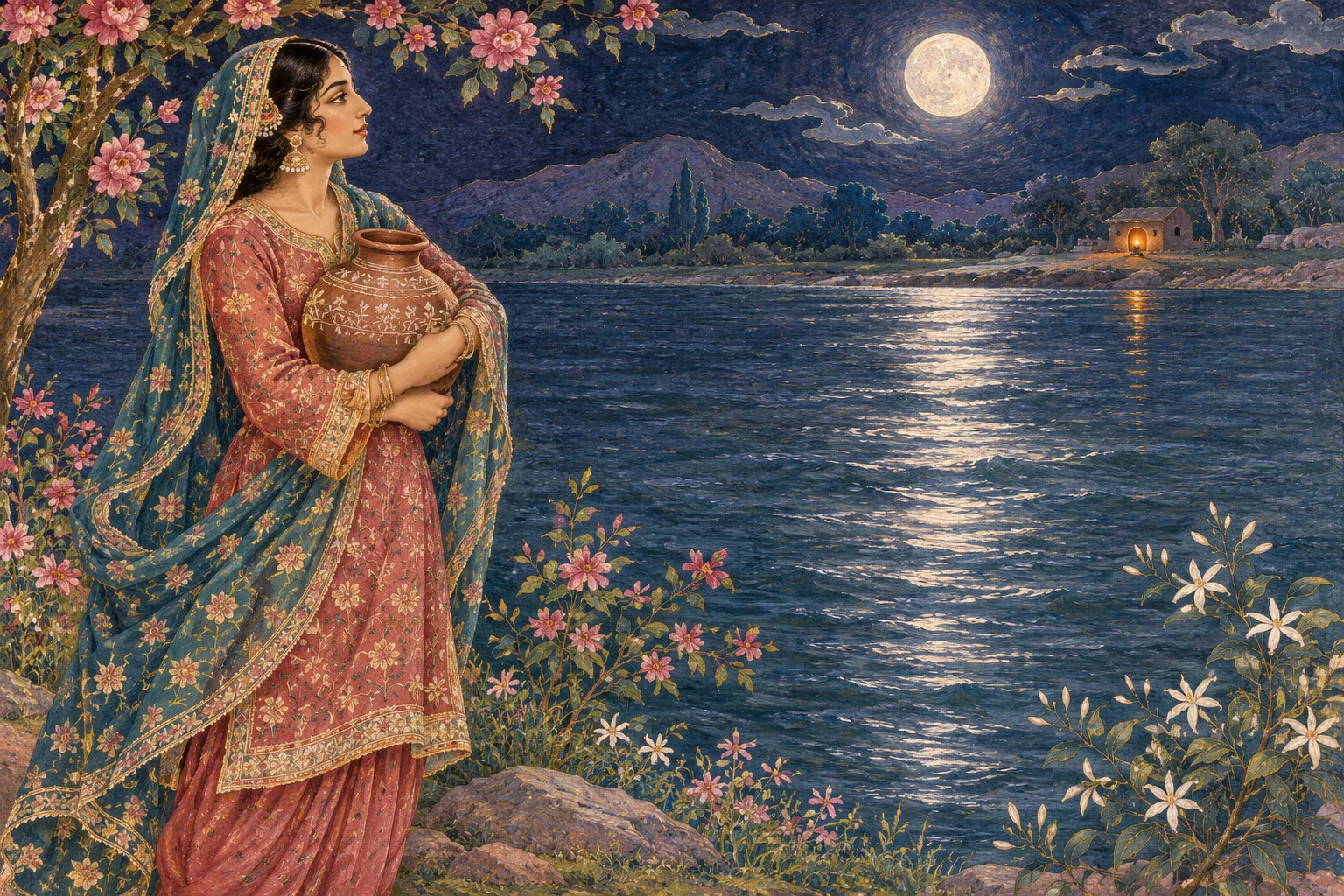
The lovers’ attachment meets opposition, and Sohni is married into another household. The river becomes both a route and a barrier. In the best-known telling, she crosses at night using a fired earthen pot for support. The vessel is not an incidental decoration. It carries the skills of the potter’s world into the centre of the narrative, joining the material of home to the danger of the crossing.
An unfired pot is substituted for the one that can withstand the water. When Sohni enters the river, the clay gives way. The story ends in the deaths of the lovers. The person who replaces the vessel and the circumstances of the final scene vary across tellings. Those differences are part of a living narrative tradition, and deserve to remain visible rather than being tidied into false certainty.
What the image can hide
The familiar picture of a woman with a pot can make the story seem simple: courage on one side, danger on the other. Read more slowly and other questions appear. What kinds of work sustain the household? Who decides a marriage? Who has freedom to travel, and who must move secretly? Why does a woman’s choice become a matter for an entire family to police?
These are reading questions, not a claim that a literary story can stand as a complete social history. The river also takes on spiritual meanings in Sufi interpretation, where crossing can suggest the difficulty of seeking union. A reader may attend to that dimension while another notices the physical knowledge contained in clay, firing and water.
Reading, remembering, discussing
A careful cultural page should name its source version and distinguish a dramatic painting from a documentary photograph. It should also avoid presenting river crossing at night as an action for readers to imitate. The power of a tragic qissa lies in what it allows us to feel and question, not in instructions for proving devotion through danger.
Sohni Mahiwal belongs beside the farming and craft pages because the landscape is part of its language. A river is livelihood and memory as well as an obstacle; a pot is skilled work as well as a symbol. When a family tells the story differently, that difference can begin a conversation about where they learned it, which words they remember and what they think Sohni was trying to choose.