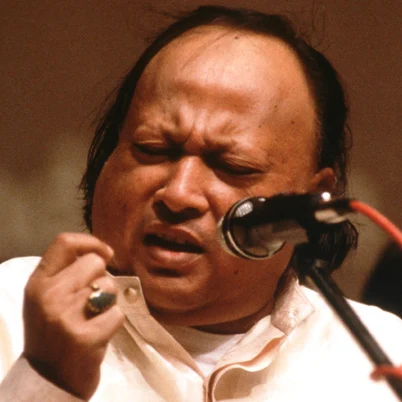
Nusrat Fateh Ali Khan da janam 1948 vich Lyallpur, hun Faisalabad, vich hoya. Ohna di qawwali ne duniya bhar de lokan nu ik taqatvar Sufi sangeet di riwayat naal milaya. Par qawwali sirf ik gaayak di awaaz nahi. Saathi gaayak, harmonium, taal, taariyan te sunan wale ral ke mehfil da rang banaaunde ne. Nusrat ne riwayati qawwali de naal Michael Brook varge kalakaraan naal nave sangeetak tajarbe vi kite. Mustt Mustt te Night Song ohde kujh mashhoor album ne. Ohdi awaaz pasand aave taan agla sawaal vi puchhiye: kalam kis da hai, lafzan da matlab ki hai, te eh mehfil kithe judi hai? Poori peshkaari sunna te saare kalakaraan nu pehchanna vi is virse da satkaar hai.
Poora khoj lekh — English
Listen to the gathering
Nusrat Fateh Ali Khan was born in 1948 in Lyallpur, now Faisalabad. He became one of the best-known performers of qawwali, a South Asian Sufi devotional tradition. His recordings and performances reached audiences far beyond the communities in which that tradition had long been heard. He died in 1997, leaving a large recorded legacy and an influence that continues through musicians and listeners.
It is useful to begin by listening to the whole performance rather than only the most spectacular vocal phrase. Qawwali is made by an ensemble. Supporting voices, harmonium, rhythm, repetition and the relationship with the audience all help create its movement. Recognising the party alongside its lead singer gives a fuller account of the labour and tradition behind a famous name.
Tradition and encounter
Real World Records, which worked directly with Nusrat, documents both traditional qawwali releases and collaborations with artists including Michael Brook. Mustt Mustt, released in 1990, and Night Song, released in 1996, are examples of a recording career that explored new sonic settings while his traditional performances also remained important. The label’s later Chain of Light release draws on recordings made in its studios in 1990.
These different recordings should not be treated as interchangeable. A concert, a devotional gathering, a studio qawwali and a collaborative album each have a setting and a purpose. For a new listener, noticing those differences is a better beginning than deciding that one version represents the entire tradition. The words, their poet, the language and the performance context deserve attention as well as the voice.
A bridge made through listening
Nusrat’s international career gives Sadda Punjabi Virsa a way to discuss connection without flattening religious meaning. A listener may respond to rhythm or emotion before understanding a line, but curiosity should lead onward: who wrote the poetry, what does the imagery mean, and how is the piece understood by people within its tradition? Translation and context can deepen an encounter that begins with sound.
His achievement does not mean that every qawwal must sound like him or seek an international market. The health of a living tradition also depends on teachers, accompanists, local audiences and spaces where younger performers can learn. A cultural website can celebrate global recognition while directing attention back to those supporting relationships.
This profile is an invitation to discover authorised recordings, read credits and listen to complete performances. It does not offer downloads of copyrighted albums or imply a partnership with the artist’s estate or record labels. From Faisalabad to audiences around the world, the lasting story is of a musical practice made newly audible across distance—and of the care required to hear more than a famous voice.