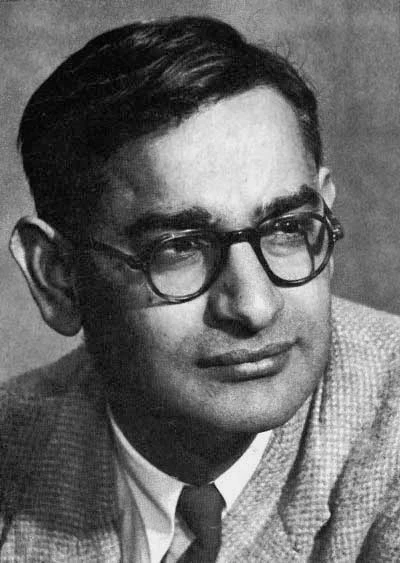
Har Gobind Khorana da janam 1922 vich Raipur, us vele de Punjab vich hoya, jo hun Pakistan vich hai. Ohna ne Multan te Lahore vich parhai kiti, fer kai mulkan vich khoj da kam kita. 1968 vich ohna ne genetic code te protein bannan de amal nu samajhan layi do hor khojiyan naal Nobel inaam sanjha kita. Ohdi mehnat vich tajarbe, sabar te saathiyan da kam shamil si. Eh kahani kise ik mulk di malkiat nahi, ilm de safar di misaal hai. Parivaar da hausla, ustad di tavajjo te scholarship ik bache da raah badal sakde ne. Khorana di yaad sanu nave vidyarthiyan layi parhai te khoj de mauke paida karan val bulaaundi hai.
Poora khoj lekh — English
A small place with a large horizon
Har Gobind Khorana was born in 1922 in Raipur, a village in the Punjab of British India that is now in Pakistan. His Nobel autobiography describes a modest childhood and a father determined that his children should learn. He attended D.A.V. High School in Multan and continued his studies at Punjab University, Lahore. A scholarship later took him to Britain, and his working life also included Switzerland, Canada and the United States.
His path is a reminder that the history of Punjab’s education cannot be contained neatly inside today’s national borders. The place where a person was born, the institutions that trained them and the communities they later served may belong to several maps. We can recognise those connections without trying to take exclusive possession of an international scientific life.
Understanding the genetic code
In 1968 Khorana shared the Nobel Prize in Physiology or Medicine with Robert Holley and Marshall Nirenberg for interpreting the genetic code and its role in protein synthesis. His experimental work helped connect sequences of nucleic-acid building blocks with the production of proteins. The team’s later work on synthesising genes became another important part of molecular biology’s development.
These achievements came from careful experimental design, chemistry, collaboration and persistence. A profile for young readers should retain that practical texture. Discovery is not only a sudden brilliant thought. It is also the willingness to repeat a difficult process, write down what happened and learn why an expectation failed. That makes Khorana’s story valuable far beyond a science classroom.
An inheritance of opportunity
Khorana joined MIT in 1970 and remained connected to research and teaching for decades. MIT’s account of the Khorana Program describes a later educational legacy in which young Indian scientists could gain international research experience. The programme is one example of how a celebrated scientist’s name can become a bridge for people who come after him.
He died in 2011. His story invites practical questions for Punjabi families: is there a quiet place to study, a teacher who notices a child’s interest, a route to scholarships, or a way for a student abroad to mentor someone at home? These questions belong in a culture conversation because opportunity is passed between generations through everyday choices.
Calling Khorana a hero here is an invitation to read about his work, not a claim that his achievements belong to one community alone. His Punjab background, international institutions and shared Nobel recognition show how much becomes possible when knowledge moves. The strongest tribute is to help another learner move with it.