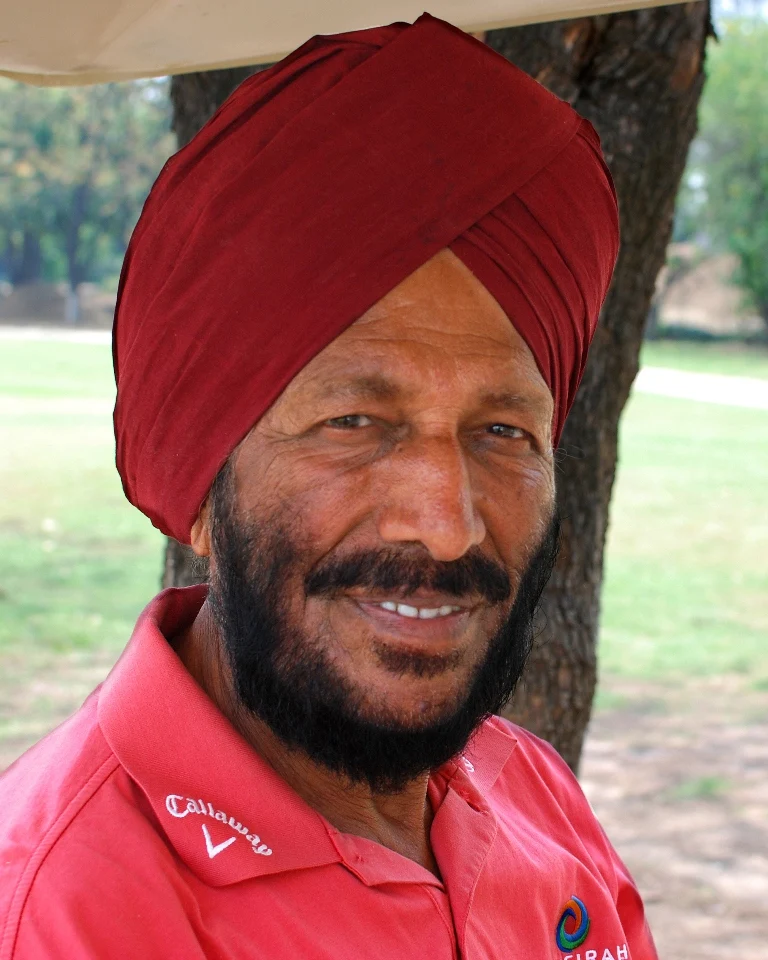
Milkha Singh da janam Govindpura, us vele de Punjab vich hoya, jo hun Pakistan vich hai. 1947 di vand vele ohna ne parivaar de jee gavaaye te India val chale gaye. Baad vich fauj di naukri duran oh daur de maidan naal jude. Ohna ne Commonwealth te Asian Games vich kaamyabi haasil kiti te tin Olympics vich India di numaindgi kiti. Rome de 1960 Olympics di 400 metre daur vich oh chauthe aaye. Eh kahani sirf jitt di nahi: bahut changi daur vi khidari layi niraasha ban sakdi hai. Ohdi zindagi nu yaad karde hoye bachpan da dukh vi izzat naal suniye. Khed layi surakhiyat maidan, changi sikhlaai te haar ton sikhan da hausla vi zaroori ne.
Poora khoj lekh — English
A life divided by 1947
Milkha Singh was born in Govindpura in the Punjab of British India, a place now in Pakistan. His childhood was violently interrupted by Partition. In accounts of his life, he recalled losing family members and escaping to India. This history should be approached with care: the experience of a child who survived violence is not an adventure story, nor evidence for blaming an entire community.
His later achievements do not cancel that loss. They show that a person’s life can contain both lasting grief and extraordinary effort. For readers whose families also migrated, his story may make room for a familiar complexity: attachment to a birthplace, memories of fear, gratitude for survival and pride in a new life can exist together.
The athlete at work
Singh found a route into competitive athletics while serving in the Indian Army. He represented India at the Olympics in 1956, 1960 and 1964, won the 1958 Commonwealth Games 440 yards, and earned Asian Games titles. The performance most often remembered is his fourth-place finish in the 400 metres at the 1960 Rome Olympics. World Athletics records a time of 45.73 seconds and notes how long his national record endured.
The fourth place matters because sport is not composed only of victories. A race can be an exceptional performance and a source of personal disappointment at once. Training, recovery, coaching and repeated competition form the work behind a brief public result. Punjabi village sport can learn from this fuller picture: effort deserves respect, and athletes need conditions in which effort can develop.
A shared sporting memory
Milkha Singh died in June 2021. His return to compete in Lahore and the friendships associated with sport have become part of the wider way people remember him. It is important to separate verified sporting records from later film scenes and popular retellings. A biographical film is an interpretation, not a substitute for an athlete’s record or first-person testimony.
For Sadda Punjabi Virsa, his life belongs beside kabaddi grounds and village running tracks as a reminder that sporting heritage includes preparation, character and access. Who can use a safe ground? Can girls participate? Is good coaching available outside large cities? Is losing treated as a chance to learn rather than a reason for humiliation?
Calling him a hero should encourage these practical conversations. His story crosses a birthplace in western Punjab, a career representing India and the international language of athletics. It can be held in common without requiring us to agree about every political border. We can honour the athlete while remaining gentle with the child who had to begin again.