Paani bachaan da faisla pump chalaun ton pehlan shuru hunda ae. Kehri fasal ae, kehri umar te ae, mitti kiven di ae te paani di quality ki ae? Ikko vakfe naal har khet nu paani dena theek nahi. Tareekh, meenh, sinchai da samaa jaan maapi matra te fasal di haalat notebook vich likho.
Laser land levelling zameen utte paani di vand sudhar sakdi ae. Khaal di murammat te sanjhi dekh-bhaal vi zaroori ho sakdi ae. Drip system vich filter, dabaa, emitter te safai da kam theek hona chahida ae. Sirf pipe laun naal bachhat di guarantee nahi mildi.
Jhone layi PAU ghatt muddat diyan kismaan, sahi beejan jaan laun da vela, te munasib haalat vich direct seeding vargiyan chonan bare dassdi ae. Eh har khet layi ikko nuskha nahi. Maahir kolon ilaqe di taza salah lao. Nave tareeqe da kharcha, fasal te asal paani varton di tulna karo. Solar pump di sasti urja vi paani da hisaab rakhan di lor nahi mukaundi.
Poora khoj lekh — English
Start with the water budget
An irrigation decision begins before the pump is switched on. What crop is being grown, at what stage, in which soil, with water of what quality? How reliable is the supply? The same watering interval cannot fit a young orchard, a mature fodder field and rice grown under another establishment method. Write down the actual irrigation pattern rather than relying only on what the neighbour did.
Our suggested farm notebook records date, field, crop stage, rainfall, irrigation duration or measured volume and observations before and after watering. This does not replace technical design, but it gives an adviser a much clearer starting point.
Make distribution more even
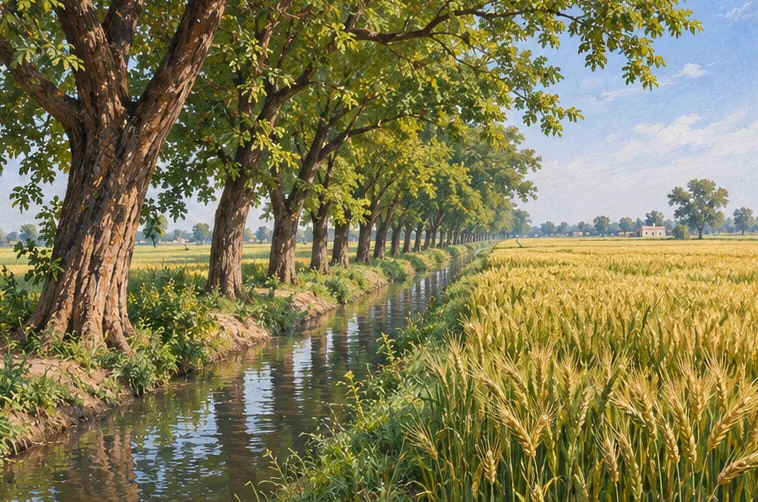
Punjab Pakistan's water-management programme includes laser land levelling and improvement of watercourses. These interventions address the journey of water to the field and its distribution across the surface. A field with uneven high and low areas may receive excess water in one place while another remains short.
Ask whether a levelling service, repaired bund, appropriate field length or improved conveyance would solve the main problem before purchasing a new system. Where neighbouring growers share a watercourse, agree on maintenance and record changes in distribution. Fair delivery to tail-end users matters as well as the total quantity entering the system.
Drip requires a working system
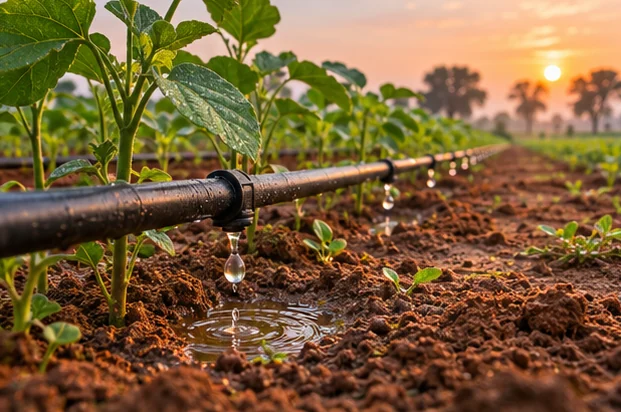
Drip and other high-efficiency irrigation systems can place water near the root zone, but design and operation are part of the result. Filtration, pressure, emitter spacing, water quality and maintenance need to match the crop and site. A clogged or uneven system is not efficient merely because the pipes are labelled drip.
The Punjab agriculture department describes several systems, including drip, bubbler and sprinklers, and identifies crop requirements, soil and available water as selection factors. Ask a supplier for the design assumptions and maintenance plan. Compare operating costs and service support, not only the installation price or a promised percentage saving.
Rice needs crop-specific choices
PAU's rice guidance discusses short-duration varieties, suitable establishment dates, alternate wetting and drying and direct seeding under appropriate conditions. These are specific management choices rather than a universal instruction to stop all irrigation. Direct-seeded rice, in particular, needs suitable land, establishment and weed management.
The university also describes soil-moisture-based scheduling and water-saving technologies. A farmer should obtain the current regional recommendation before transferring a technique to a different soil or district. On the website, a reported saving should retain its crop, comparison and source; one trial's percentage should not be advertised as a guarantee for every Punjabi farm.
Measure the result and share it
Our proposed water story follows a field for a season. Show the original problem, the chosen intervention, what it cost to run, whether the crop remained healthy and what was measured. Include a setback such as a clogged filter or a missed irrigation. A practical account is more valuable than a photograph of newly installed pipes.
Solar pumping also deserves a water budget: cheaper energy does not itself decide how much groundwater a farm should withdraw. Pair any equipment discussion with crop planning and monitoring. Saving water means reducing avoidable losses while meeting a justified crop need, then keeping the saving visible in the record.