Khet di peeli fasal jaan chitti parat vekh ke poora kaaran nahi dassia ja sakda. Mitti di banatar, sakhti, namak, khuraak, nikaas te paani di quality ik-dooje naal jud sakde ne. Masle wali thaan nakshay utte nishaan lao te laboratory kolon sahi namoona lain da tareeqa puchho.
Punjab diyan mitti-paani labban zarkhezi, namak wale masleyan te sinchai de paani di jaanch kardiyan ne. Sirf mitti chitti vekh ke gypsum na pao. Compost vi har namak wale masle da ikalla ilaaj nahi. Test te maahir di salah mutabik paani, nikaas te zaroori sudhaar da plan banao.
Faslaan di rahind-khoond, khaad te organic maadda vartan da record rakho. Parali khet vich rakhan jaan bahar bhejan de faisle vich machine, samaa, kharcha te mitti ton jaandi khuraak vi vekho. Fasal di rotation, sinchai, test te sudhaar kai ruttan tak likho. Ik sohni tasveer lamme same di sehat da saboot nahi. Changi kahani oh ae jithe kisaan apne faisle te natije samjha sake.
Poora khoj lekh — English
A photograph cannot diagnose every problem
A pale patch, crust or weak crop may prompt a useful question, but an image alone rarely explains the cause. Soil texture, compaction, nutrient status, drainage, salinity, water quality and crop history can interact. Begin with a field sketch showing where the symptoms occur and what changed recently.
Ask the local laboratory how to collect a representative sample and which tests are appropriate. Keep unusual patches separate when advised, and provide the crop and irrigation history. A laboratory number is most useful when it can be connected to the depth, place and date from which the sample came.
Salinity and sodicity need a diagnosis
Punjab Pakistan's Salinity Research Institute describes both reclamation and adapting land use to salt-affected conditions. The department's soil-and-water laboratories test soil fertility, irrigation-water suitability and problem soils. These services illustrate why a blanket recipe is unreliable: the problem must be identified before an amendment is selected.
Do not apply gypsum simply because a field looks white, and do not expect compost alone to correct every salinity problem. Ask for a site-specific recommendation that considers water quality, drainage and the kind of salt-related constraint. The water used to irrigate the field may be part of the problem.
Build organic matter with a plan
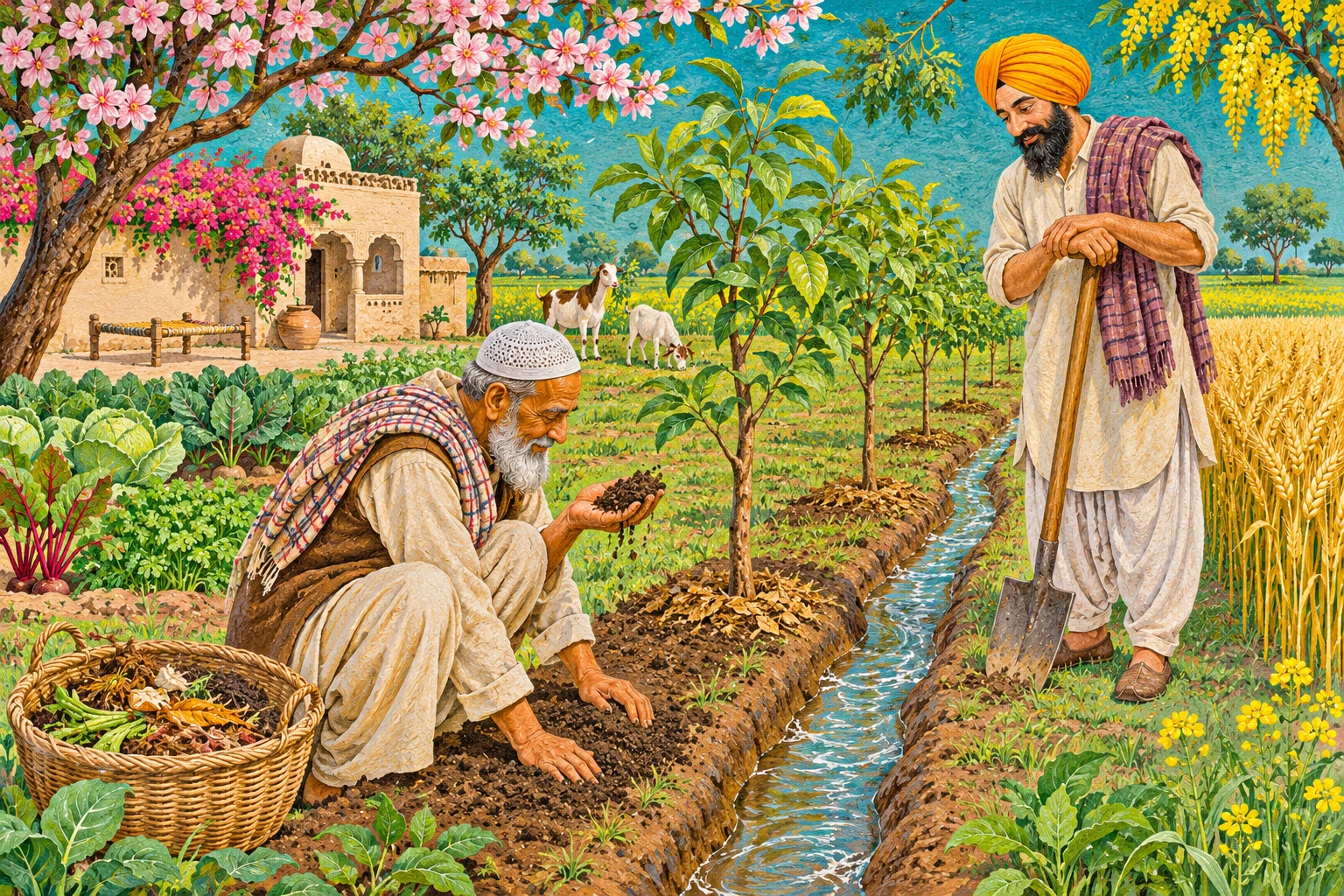
Crop residues, manures, compost and living roots can be discussed as parts of a soil-management plan. What is available locally, how mature or clean is it, how will it be applied and what nutrients does it contain? The aim is to manage a biological resource responsibly, not to promise that a single bag of an input will restore the whole field.
Record additions and subsequent observations. For food crops, handle animal-derived materials and harvested produce according to appropriate hygiene guidance. A farmer's positive experience is useful evidence of that field's management, but it should not be turned into an unsupported claim that a particular material prevents every disease.
Residue management connects soil and air
ICAR's Punjab crop-residue discussions consider both in-field uses and removal for other value chains. They emphasise matching machinery to actual conditions and replenishing nutrients when residues leave the field. This is a useful basis for practical reporting: where did the straw go, who collected it, and how did the next crop establish?
The website should show farmers the people and services involved, including rental machinery and local collection arrangements when verified. A technique that cannot be accessed at the right time may fail for reasons unrelated to its agronomy. Document labour, timing and cost alongside the environmental objective.
Follow change over several seasons
Our proposed soil notebook records crop sequence, irrigation source, test results, amendments, residues, tillage and visible problems. Repeat observations in comparable locations. Compare trends carefully: weather, crop and sampling method may differ between years. One striking photograph after rain cannot establish a long-term improvement.
Soil care also links to crop choice. ICAR and PAU's region-specific work support the broader principle of aligning farming with local resources. Include pulses, fodders, orchards or agroforestry only where they fit the farm's conditions and livelihood. The most persuasive revival story is a field that remains productive, a farmer who can explain the decisions and a record that others can learn from.