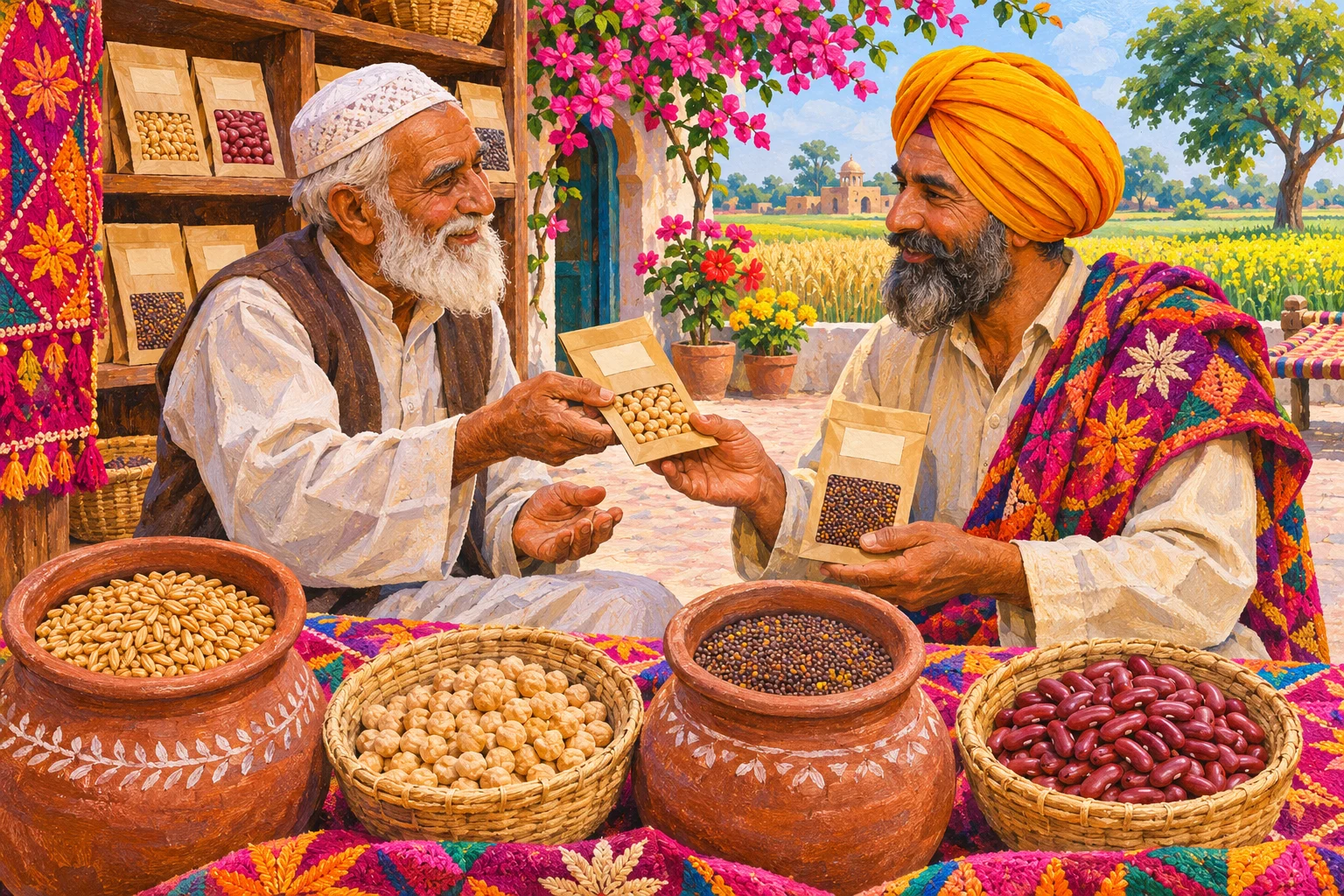
Sanjha Beej sirf daana vandan da naa nahi. Beej de naal ohda local naa, pind, sambhalan wale bande di kahani te fasal da record vi bachna chahida ae. Sadda Punjabi Virsa utte eh sanjhe beej-gyan da visha ae; is naa di ikko sanstha jaan saadi kise naal bhaivali di tasdeek nahi hoi.
Pakistan vich PARC da National Genebank paudian de beej te hor vanshaki samaan nu sambhalda ae. Indian Punjab vich Kheti Virasat Mission apne kam vich beej-sambhaal di sikhlaai te parivaarak seed bank dassda ae. Inhan da kam vakhra ae, par jaankaari ik-dooje layi faidemand ho sakdi ae.
Apne record vich fasal, beej da srot, pind, mausam, katai da saal te uggan di jaanch likho. Buzurg di yaad nu izzat deo, par ohnu jaanch da natija na aakho. Nave beej nu pehlan chhoti patti vich azmao. Sarhad paar kahaniyan te tajarbe sanjhe karo; asal beej bhejan ton pehlan paudian di sehat te aamad de niyam samjho.
Poora khoj lekh — English
Begin with the keeper
Ask an elder what the family grew, and the answer may be a name absent from a seed catalogue: a wheat remembered for its roti, a climbing bean associated with one courtyard, or a millet cooked on particular days. Such memories are leads for documentation. They do not establish a variety's identity on their own. A useful record brings together the local name, the grower's account, a dated photograph and a sample whose origin can be traced.
On Sadda Punjabi Virsa, Sanjha Beej describes this shared-knowledge theme. Our research has not verified a single organisation with precisely that name to which all these activities belong. We therefore keep the theme separate from named organisations and avoid claiming partnerships that have not been agreed.
Two kinds of conservation
A seed kept in a cold store and a crop renewed in a farmer's field serve different purposes. Pakistan's National Genebank at PARC maintains plant genetic resources for conservation and research. Its seed-request process asks users to identify requested material and acknowledge the source. It is not a promise that every heritage crop is immediately available for unrestricted commercial sale.
In Indian Punjab, Kheti Virasat Mission describes village mapping, seed-conservation workshops and family seed banks. Its own account documents an effort to reconnect growers with seed keeping. Institutional collections and field-based conservation can complement one another: one safeguards material, while the other preserves observation, culinary knowledge and adaptation under cultivation.
Keep the story with the packet
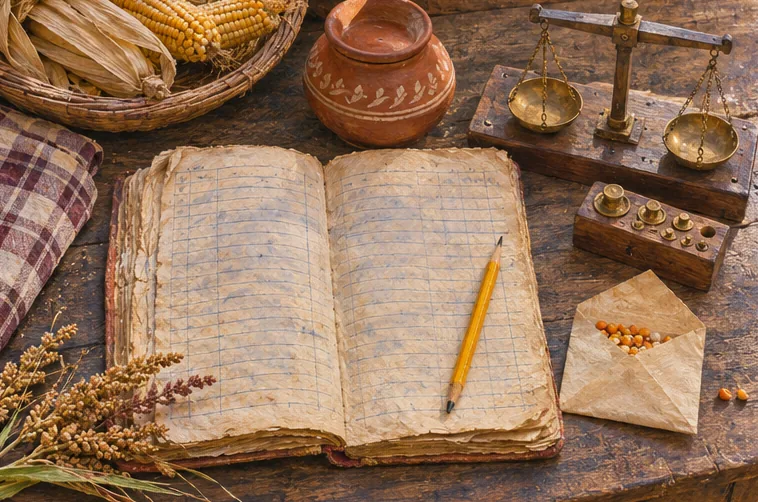
Our suggested seed record has seven parts: crop and local name; scientific or confirmed varietal identity where known; village and growing conditions; grower's name with permission; sowing and harvest season; seed-generation and source history; and observations about performance. Add the harvest year, storage method and a recent germination result. Clearly distinguish a family recollection from a laboratory result.
A photograph of a handful of grain is attractive, but it cannot show every trait. Photograph the plant, leaf, flower, fruit and mature seed where useful. If the identity remains uncertain, label it as a local sample awaiting identification. Several villages may use the same name for different material, or different names for the same crop.
Start with a small, useful trial
Before depending on an unfamiliar seed lot for the household's full crop, grow a small comparison strip. Record the seed rate, irrigation, soil conditions, disease observations and harvest. Compare cooking or fodder quality as well as the quantity produced. A traditional variety worth conserving may have a valuable use even when it is not the highest-yielding choice for every field.
Neighbours can agree on a seed-renewal plan so that several households do not all lose the same material in one bad season. Women, tenant farmers and kitchen gardeners should be included in the record, not only the person whose name appears on the land document.
Share knowledge across the border responsibly
The website can connect descriptions, photographs, interviews and growing experiences from both Punjabs. Moving physical seed across national borders is a separate matter that can involve plant-health, import and variety-rights requirements. A public exchange post should therefore invite knowledge sharing without promising unrestricted international seed delivery.
The immediate aim is practical and achievable: preserve a trustworthy record, identify real keepers, link readers to genuine institutions and encourage locally appropriate trials. A seed survives through repeated care. Its cultural meaning survives when the people who cared for it are also remembered.