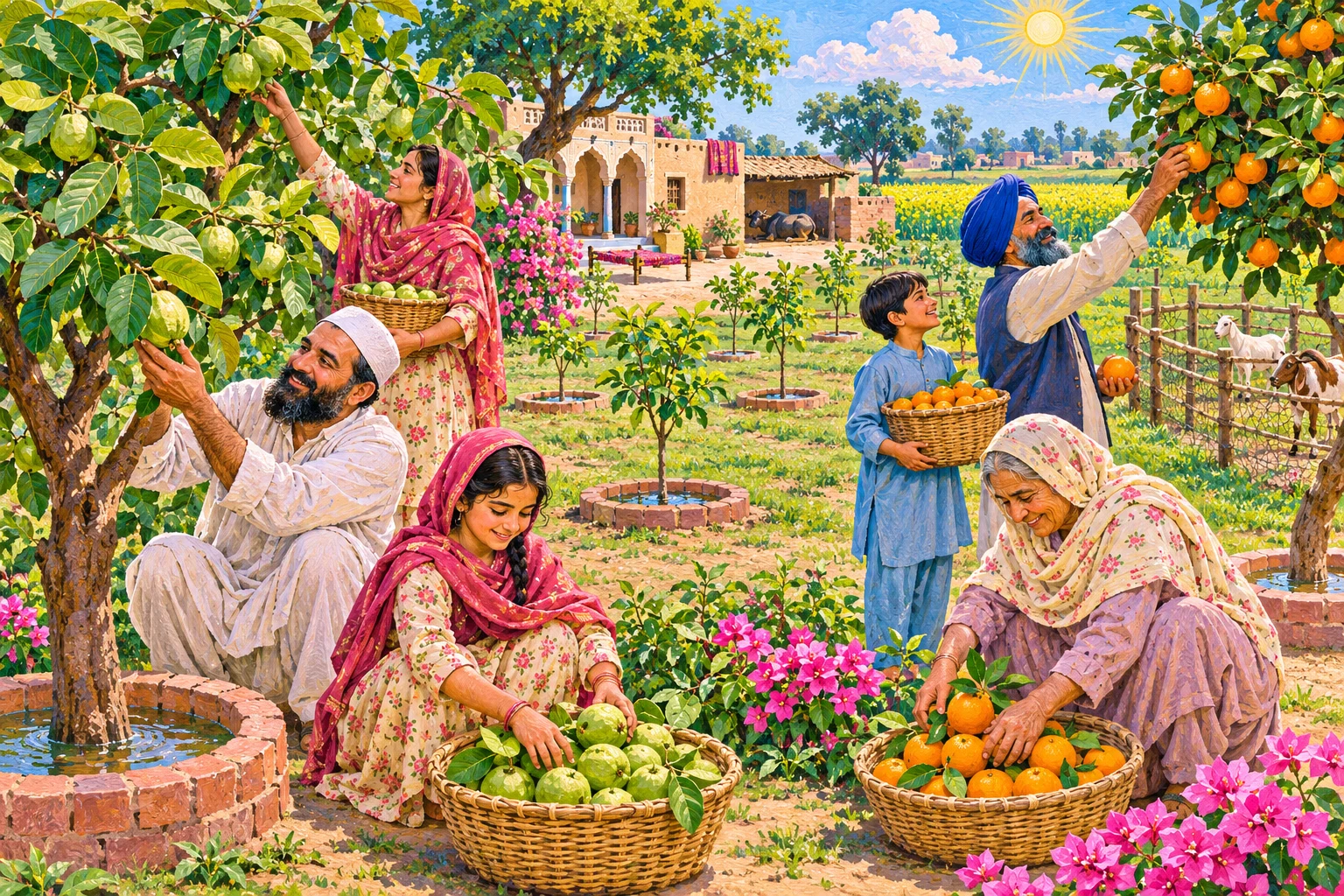
Amb, kinnow, amrood, ber te jamun Punjab diyan kai yaadan naal jude ne. Par pasandida phal har khet layi theek nahi hunda. Apne nerle baaghan vich kehri kisam changi chaldi ae, eh jaano. Sardi, garmi, nikaas te paani di quality zameen di chon badal sakde ne.
Baagh kai saalan da faisla ae. Mitti di teh te sinchai de paani di jaanch boote khareedan ton pehlan karvao. Bharoseyog nursery kolon kisam, sehat, paivand te rootstock di jaankaari lao. Paivand launa te beej nu F1 hybrid aakhna vakh gallan ne. Kinnow di hybrid asal vi documented ae; eh Punjab de baaghan vich ohdi thaan nu nahi mitaaundi.
Planting de naal paani, mehnat, chhantai, bimari, phal torn, transport te khareeddaar da plan banao. Chhote boote foran poori aamdani nahi dinde. Har phal layi ikko munafe jaan paidavaar da waada na mano. PAU te Sargodha-Multan de kheti idare ilaqe mutabik madad de srot ne. Apne baagh da record rakho te nuksaan vi imandari naal likho.
Poora khoj lekh — English
A village favourite is a starting point
Mango, kinnow, guava, ber, jamun and other fruits connect many families with Punjab, but cultural affection does not settle the agronomy. Ask which varieties already produce well in the immediate area and why. Differences in winter cold, summer heat, water quality, drainage and soil can change the answer within a district.
PAU's fruit package and region-specific research distinguish growing zones and management needs. In Pakistan, the Citrus Research Institute in Sargodha and Mango Research Institute in Multan represent specialised regional knowledge. Use those institutions to frame a local question rather than copying a planting plan from a distant farm.
Look below the surface
An orchard is a long-term use of land. The Punjab Pakistan laboratory service describes deeper soil assessment for orchard establishment alongside irrigation-water testing. Ask about the soil profile, drainage, salt problems and reliable water supply before ordering plants. A field that carries a seasonal crop may still contain a subsoil constraint important to a permanent tree.
Record the previous crop, any waterlogging, dry patches and the source of irrigation. Test results should guide a site-specific decision. The planting decision is easier to change on paper than after several years of caring for an orchard that was poorly matched to its soil.
Buy identity and health, not only height
Know the cultivar and propagation method, and obtain plants from a reliable nursery. A grafted fruit plant combines a chosen fruiting variety with a rootstock; that is a different description from calling a seed lot an F1 hybrid. Ask for the rootstock where relevant and for evidence of nursery plant health.
Kinnow illustrates the importance of precise language. UCR documents its King-Willowleaf hybrid parentage, while Punjab's institutions provide cultivation guidance for the region. Being a hybrid does not prevent a fruit from becoming part of Punjabi life. For each orchard crop, describe origin, adaptation and management as distinct pieces of its story.
Match the orchard to the household
Ber's tolerance of difficult conditions is documented by Punjab's agriculture department, yet a commercial planting still needs a suitable cultivar, care and market. Mango, citrus and guava also require decisions about pruning, nutrition, pests, harvest and handling. No fruit is an income machine that can be left unattended after planting.
Our suggested planning sheet includes land preparation, plants, irrigation, protection, labour, expected non-bearing years, harvest work, transport and a buyer or household use. Use local quotations rather than a universal income figure. Keep a reserve for replacement plants and management problems. Prices and yields change; the field record should show its assumptions.
A diverse orchard can still be planned
A home fruit garden may prioritise harvests through different seasons, shade and family preference. A commercial block may need uniformity and efficient management. An intercrop can be useful while young trees leave room, but it must be compatible with water, light and orchard operations as the canopy develops.
On Sadda Punjabi Virsa, an orchard story should return to the same grower over time. Show how plants established, what failed, how water was managed and where the harvest went. This connects the beauty of blossom and fruit with the work that makes a baagh viable. The best recommendation is the one a local grower can explain, afford and sustain.